Signs of Rising Damp
Find out more about the signs of rising damp

Call to Book a Survey +448083018423 or Contact Us Online
A rising damp problem problem can lead to damp patches, salty residue, rotting skirting boards and deteriorating plasterwork. Because rising damp is often confused with other types of damp, it is vitally important to accurately diagnose the problem, before carrying out remedial treatments.
If the wrong treatment is carried out, this will not stop the root cause of your issues. This is why a professional survey to fully identify the extent of the problem is key. Once a rising damp problem has been confirmed, remedial damp proofing will be necessary to fix your problem.
We have put together a guide on what to expect with treating rising damp problems, and what work our experienced technicians will carry out to ensure your property is free from damp.
The only reason you will need rising damp treatments is when the damp proof course on your property has failed, is missing or has broken. In the case of slate damp proof courses, these can crack due to subsidence and groundwater can then rise upwards. Because there is no longer a waterproof barrier protecting your walls, ground water is able to rise up the masonry through capillary action. Therefore a new waterproof barrier needs to be installed.
If you have a functioning damp proof course, but there is still damp inside your property - the root cause will more than likely be penetrating damp or condensation.
Sometimes rising damp can occur because a functioning damp proof course has been bridged either by heightened ground levels, flower beds or by building defects. This does not necessarily mean you need rising damp treatments - a professional surveyor will be able to provide recommendations on how to solve this problem by carrying out a damp and timber survey.
You will only need remedial rising damp treatments if rising damp is confirmed. This is why it's important to use a qualified surveyor who will give you honest and professional advice.
For an accurate diagnosis for rising damp a professional surveyor can investigate thoroughly, Rentokil Property Care has a number of CSRT and CSTDB qualified surveyors who can carry out a damp and timber survey to fully understand your damp problem.
A surveyor will carry out a full inspection and identify any issues they find both inside and outside your property. They will use a range of techniques to investigate damp, aided by tools and equipment to support any diagnosis, and provide you with a full understanding of the problem.
Our local surveyor will then provide you with a survey report, detailing whether or not the problem is caused by rising damp. If they have diagnosed rising damp, they will provide you with recommendations for remedial treatments.
The survey report will be in an easy to understand format, with details of the costs involved and information on the long term guarantee, if applicable.
Once a rising damp problem has been confirmed and you wish to go ahead with remedial treatments, our Rentokil Property Care technicians will arrive on site at a time suitable to you. They will keep you informed on the processes involved, while taking care of your property from start to finish.
Our technicians will come prepared with protective floor coverings, Hilti dust extraction units and vacuums in order to keep your property clean and tidy. Where possible they will cover surfaces with dust sheets in order to keep disruption to a minimum.
A typical rising damp treatment process involves several steps, and will vary from property to property, depending on the problem.
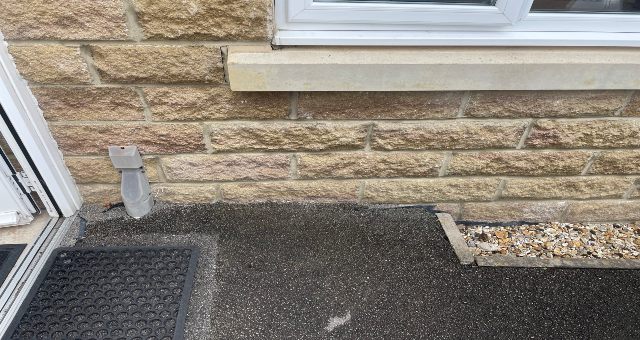
Exterior walls often suffer from rising damp problems, and sometimes this is caused by external issues bridging a damp proof course. Sometimes soil or debris piled up against the external wall is causing a bridge, so removing the excess soil back below the damp-proof course is required. The internal plasterwork may be damaged and this can be rectified once the soil is back below the DPC and the masonry dries out.
When a more permanent fixture such as heightened ground levels caused by a new pathway or drive has bridged the damp proof course, other solutions may be required.
Damp external walls can cause mortar to degrade and fall away, while bricks can become spalled, allowing further moisture into the fabric of the building. These areas may require repointing. Once the walls have dried out property, visible tidemarks caused by hygroscopic salts can be removed with a wire brush.
It may be necessary to install air bricks to provide improved ventilation to the sub floor void underneath your property. This can prevent damp problems and issues such as fungal decay.
Sometimes heightened ground levels can bridge damp proof courses, and cause damp problems internally
The most common reason property owners want remedial damp proofing is because of damp patches inside the property, and in some cases salty residue has caused the plasterwork to degrade.
This means the plasterwork has been contaminated with hygroscopic salts, and it will need to be removed.
Therefore the first step is to remove any skirting boards in the area affected, and then hack off and remove the plasterwork which has been contaminated.
Once the area has been fully prepared our technicians will begin to install a remedial damp proof course through a process of damp proof injection.
Walls must be stripped back to masonry to remove any plaster contaminated with hygroscopic salts, as these salts can pull moisture from the air and cause damp patches in the future.
The technician will drill injection holes at intervals into the mortar joints, usually 150mm above the ground level. This is the point in which the new damp proof course will be created.
A silane based damp proofing cream is then injected into the holes. This works by creating a waterproof barrier that prevents moisture from rising upwards.
The cream is injected at intervals and will diffuse into the mortar and brickwork and create a complete damp proof course.
The damp proof cream can be used on different types of masonry and is a very effective and versatile method of preventing rising damp in existing properties, where a physical damp proof membrane cannot be installed.
The next step involves replastering the walls, while allowing any residual moisture to escape which will help the ongoing drying process. The new plaster needs to be salt resistant in order to prevent hygroscopic salts within the wall migrating through and affecting the newly finished plasterwork. Once this is done decorative finishes can be applied.
Our technicians will use approved products, and adhere to the highest industry standards. When you choose Rentokil Property Care you can rest assured that all damp proofing works are carried out to the highest professional standard.
The reason walls affected by rising damp may need to be replastered is because of the presence of hygroscopic salts, most commonly nitrates and chlorides, which are present in the ground water that rises up through masonry by the process of capillary action.
These salts are present in the water that migrates to the surfaces of the plaster, and are left behind as the water evaporates. This is what causes the salty tide marks that rising damp is so often associated with.
Because hygroscopic salts can pull water from the atmosphere into the wall, it can lead to future damp patches, even if the rising damp problem has been resolved. This is why the area must be replastered - to remove the possibility of salts crystallising on the surface of plaster and causing it to deteriorate and flake away.
Visual salting may not be present at the time of installing a new dpc, but as the wall dries, they can come to the surface.
If the area is replastered with the incorrect plaster and is unable to prevent salt migration, it is possible for salts within the brickwork to pass through the new plaster. Salt retardant plaster will allow the walls to dry out by evaporation but will prevent salts from migrating through to the surface. This means your walls are protected long term from any associated damage.
The failure to use a salt retardant plaster is a common cause of visual rising damp problems, even though a new damp proof cause has been installed. This is why a professional and experienced company should be used, while being able to back up their treatments with a long term guarantee.
White powdery build ups on plasterwork and coloured salty tidemarks are commonly associated with rising damp, and they are known as salt efflorescence. The efflorescence forms when moisture within the masonry causes dissolved salts to migrate to the surface, which then crystallise as the moisture evaporates.
To prevent this from happening buildings are designed with a damp proof course, which prevents ground salts from rising upward through the wall through capillary action. This physical barrier prevents this, but if the salts are already within the fabric of the wall, salt retardant plaster will be required to create a barrier between the new plaster finish and the masonry containing the salts.
Salt efflorescence is not exclusive to rising damp however, as building defects can cause moisture to penetrate into masonry walls, commonly known as penetrating damp. This can be through driving rain, damaged roof coverings, blocked drains or gutters overflowing. When brickwork cracks, or if mortar degrades and falls away, moisture can penetrate through into the fabric of the building, especially during periods of heavy rainfall.
While regular maintenance can help prevent these issues, sometimes they have already caused damp walls and salt efflorescence to form - meaning it is essential for a trained professional to identify and diagnose the type of damp causing the problem.
Efflorescence is also the term used for salts that form on the surface of new gypsum skim plastering. These are part of the natural drying process and can be brushed or wiped off before redecoration.
Carrying out remedial damp proofing and replastering will always create some element of dust and mess, however Rentokil Property Care will take efforts to keep disruption to a minimum and leave your property as tidy as possible.
Our technicians will come prepared with protective floor coverings, Hilti dust extraction units and vacuums in order to reduce the amount of dust and debris. These dust extraction units are used to remove airborne dust from the atmosphere while removing plasterwork, drilling into masonry or cutting any timber. These help create a safer work environment for technicians, while also reducing the amount of dust settling and the dust particles moving throughout your property.
Our technicians will also make efforts to cover surfaces with dust sheets in order to keep further disruption to a minimum.
Once the new damp proof course has been installed and the affected areas replastered, there are steps you can take to prevent further issues. While the source of the problem has been addressed, if the newly installed damp proof course is bridged, problems may occur.
This means it's essential that when renovating the property you consider how this may affect the damp proof course. Any ground alterations outside or efforts such as the installation of flowerbeds abutting the property may cause issues in the future.
Make sure to keep air bricks clear throughout the property as this can help air circulate throughout the sub floor void, helping prevent damp issues and potential fungal decay outbreaks.
When replacing suspended timber floors in your property with solid floors, it is important a damp proof membrane is laid across the floor and it is detailed correctly up the wall to key in at the same height as the wall DPC. If this is not done correctly, bridging can occur.
Typically Rentokil Property Care work is backed by a long term guarantee, so in the unlikely event future problems occur in the same area, you’ve got the peace of mind your property is protected.
A typical rising damp treatment carried out by Rentokil Property Care is backed by a 30 year guarantee, giving you long term peace of mind your property has long term protection. This guarantee can be passed over to new homeowners if you choose to move property, giving the new homeowners reassurance the property is protected.
The cost of rising damp treatments will depend on the size and extent of the problem, and whether any associated works are required, such as fungal decay treatments for rotten timber.
Every property is unique, and accurate diagnosis is key in order to fully understand if the problem originated from rising damp. This is why it is so important for a qualified damp and timber surveyor to carry out a full inspection of the property - rather than getting a direct quote for rising damp costs without a full site inspection.
Often a surveyor will find no evidence of rising damp - and all that is required are simple building repairs rather than remedial damp proofing. A trained and qualified surveyor will provide you with a survey report along with recommendations for treatments, if required, along with any costs involved.
PCA approved: Rentokil Property Care are a proud member of the PCA and have a range of CSTDB, CSRT and CSSW qualified surveyors operating out of our local branch.
Trustpilot: Our damp proofing, structural repairs and timber treatments are rated ‘Excellent’ with over 1,000 reviews from our customers - showcasing our professionalism.
Long Term Commitment: From our origins in the 1920’s to the present day, we have outlived our guarantees several times over. This means you can have complete peace of mind from a Rentokil Property Care guarantee - up to 30 years for some of our services.